Installation Instructions for Outdoor Artificial Turf Applications

Providing Baseball and Softball Equipment, Artificial Turf and Sports Netting.

Providing Baseball and Softball Equipment, Artificial Turf and Sports Netting. Call 1.800.365.6171 to speak with a Turf Specialist today, or Email us. We guarantee a response by the next business day.

Click on a topic from the following list for information on that subject:

Ground Preparation

Before installing the turf, it is important that the ground on which the turf will be laid, is smooth and firm. Remove any bumps, roots, rocks, sticks or any other debris to ensure a flat surface and pack down to make it firm.

If the turf is going to border a patio or some sort of concrete slab, make sure that the surface is 5 inches below the top of the patio or driveway-like surface, because you will need to account for 4 inches of the crushed rock base.

Return to Top

Crushed Rock Base Preparation

There should be a layer of crushed rock (where the rocks are ¼ " size) between the dirt surface and the new turf. This serves as a drainable base. Depending on where you live, this may have different names. The most common are: ¼" minus compaction aggregate, road base, chat or decomposed granite. When buying the crushed rock, you will want to get approximately two tons of this crushed rock per 100 square foot, which should equate to a 4 inch thick layer, leaving 1 inch below the top of the patio/driveway. Obviously, you want to spread this as evenly as possible (with rake), compact it (with vibratory plate compactor or other device to about 90 - 95%), lightly soak it with water and then pass over it again.

Return to Top

Turf Preparation and Installation

Before cutting the turf to fit the area, start by simply laying the piece or pieces of turf over the area. There are two important considerations when laying two or more separate pieces or rolls of turf in the same area:

Grain should go in same direction

Make sure the grain is running in the same direction, before cutting. When cutting the turf for straight edges, use the tufted rows (the lines on the backing) as guides for ensuring a straight cut. Also, make sure that these tufted rows are aligned, going the same direction.

Ensure Good Seams

To stabilize two pieces of turf together, we recommend using "urethane cloth" (available to purchase at On Deck Sports) with adhesive applied to it.

  • 1. Once the pieces of turf are cut to the desired shapes and sizes, place them over the area with the tuft rows matched up properly.
  • 2. Go ahead and hammer a nail within a foot or so of the edge of the turf where the seam will be to stabilize it.
  • 3. Roll back the edges of the turf which will eventually be joined together.
  • 4. Place some sort of weight on the folded back pieces to hold them down while laying the urethane cloth.
  • 5. Lay cloth and pour on adhesive.
  • 6. Lay edges of turf back over adhesive and let dry for 1 hour.
Return to Top

Securing Your Turf

Return to Top

Installing the Infill

(If your turf requires infill)

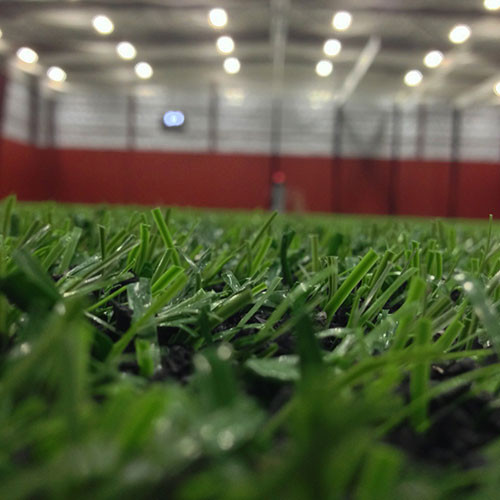
Infill can be sand, rubber pellets or a combination of both. Its purpose is to support the fibers and provide bulk to the turf to weigh it down. You get the same effect by using either sand or rubber, but they may look slightly different.

  • 1. Brush the fibers so they are standing as straight up as possible.
  • 2. Spread Infill evenly over turf with a drop spreader like you would use to spread fertilizer.
  • 3. You should use approximately 3 lbs of Infill per square foot.
  • 4. In between spreading layers of infill, use a broom to brush it into the fibers.
  • 5. The infill should total ¾ of inch in height, leaving ¼ inch of fiber above the infill.
Return to Top

Long Term Maintenance

IA leaf blower can be used to clear debris and dust every month or so. Every few months, you will want to sweep or brush the turf so that the fibers continue to stand up. Power Brooms may save considerable time on larger areas of turf.

Return to Top